Cobra · Method
AI doesn't code my request — it verifies what it assumes
An internal chain where a request for an Odoo change is described in 8 fields, submitted with its screenshots and video, and reviewed automatically — the review going to check in the real database what the request takes for granted.
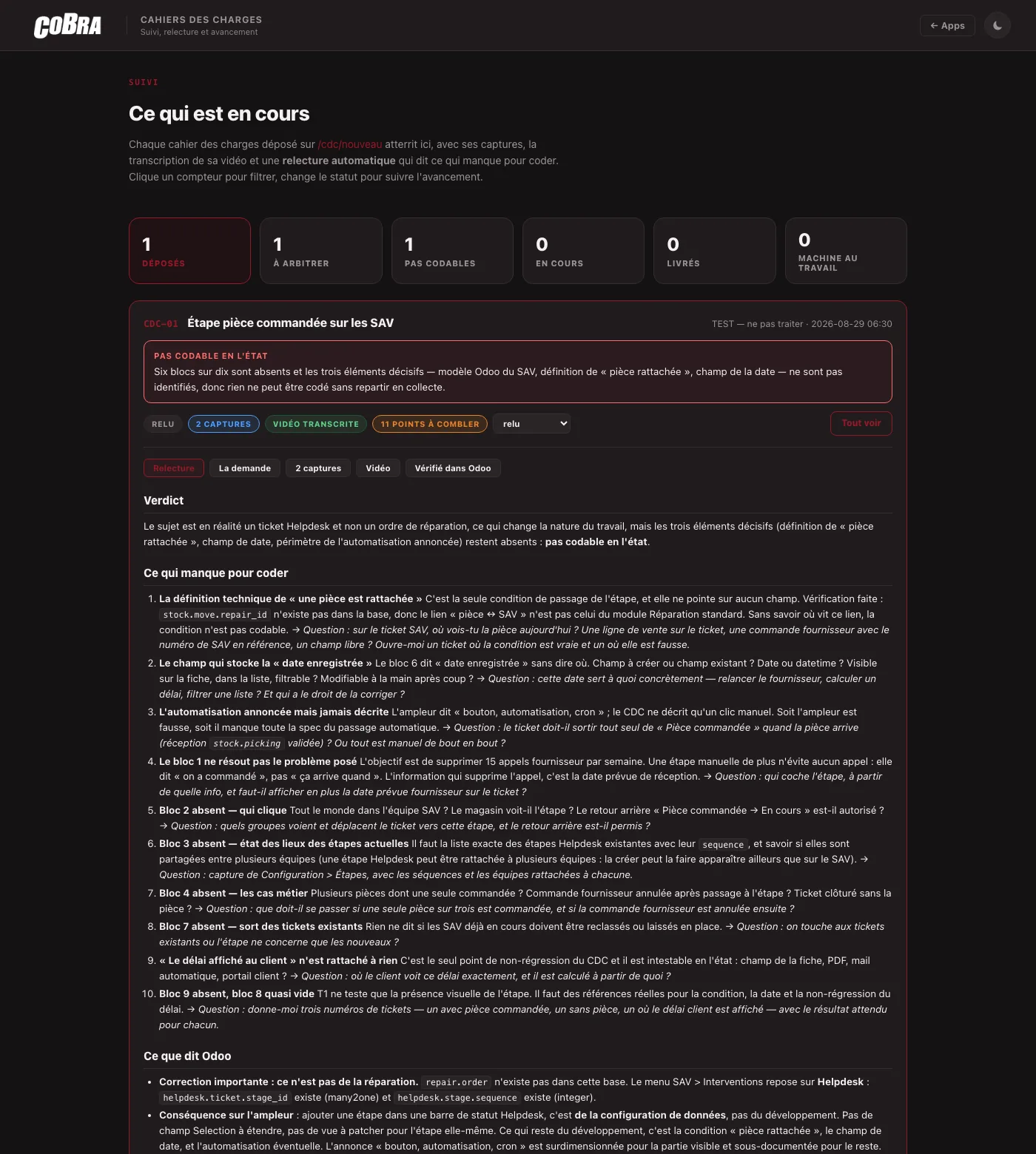
Context
Odoo change requests arrived as a one-liner in a message: "we'd need a button to…". The same three pieces of information were always missing — where exactly to put the thing, what should happen on click, and above all what must not move. The result: two or three round trips before anything moved, and now and then a change that broke something else along the way.
What was done
A complete chain, from guide to tracking:
- A method guide: ten blocks to fill, and above all a vocabulary to name the zones of an Odoo screen — "top right" points to four different places, and that's where most requests get lost.
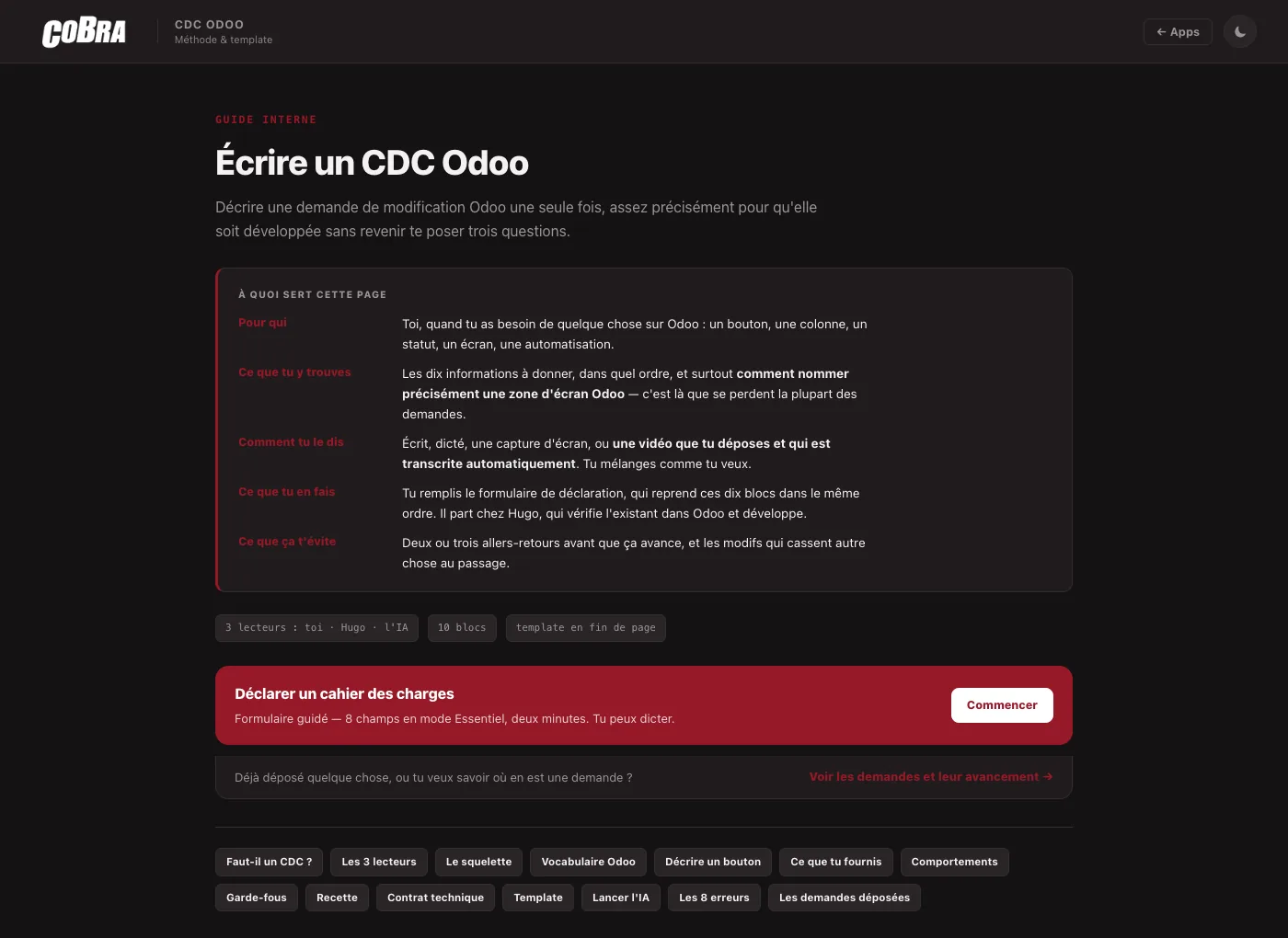
- A guided form: an Essential mode with 8 required fields (two minutes), a Complete mode for the ten blocks. The "guardrails" block becomes required automatically when the chosen scope indicates the change will write data — 11 required instead of 8, without the author having to think about it.
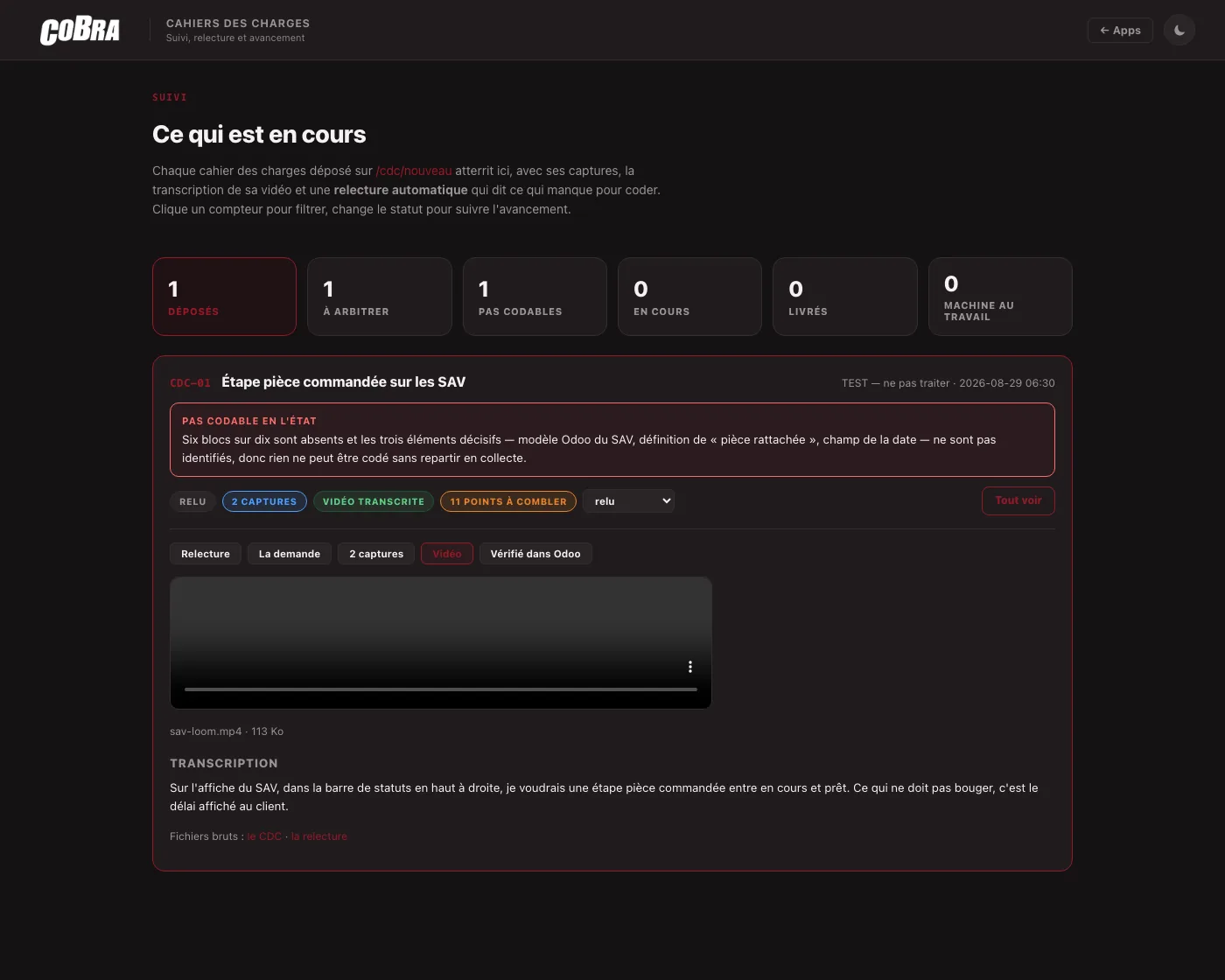
- The actual submission: drag-and-drop screenshots, video up to 400 MB. The server extracts the audio and has it transcribed; the transcript is added as an appendix to the request. Nothing left to retype.
- The automatic two-pass review (the core, detailed below).
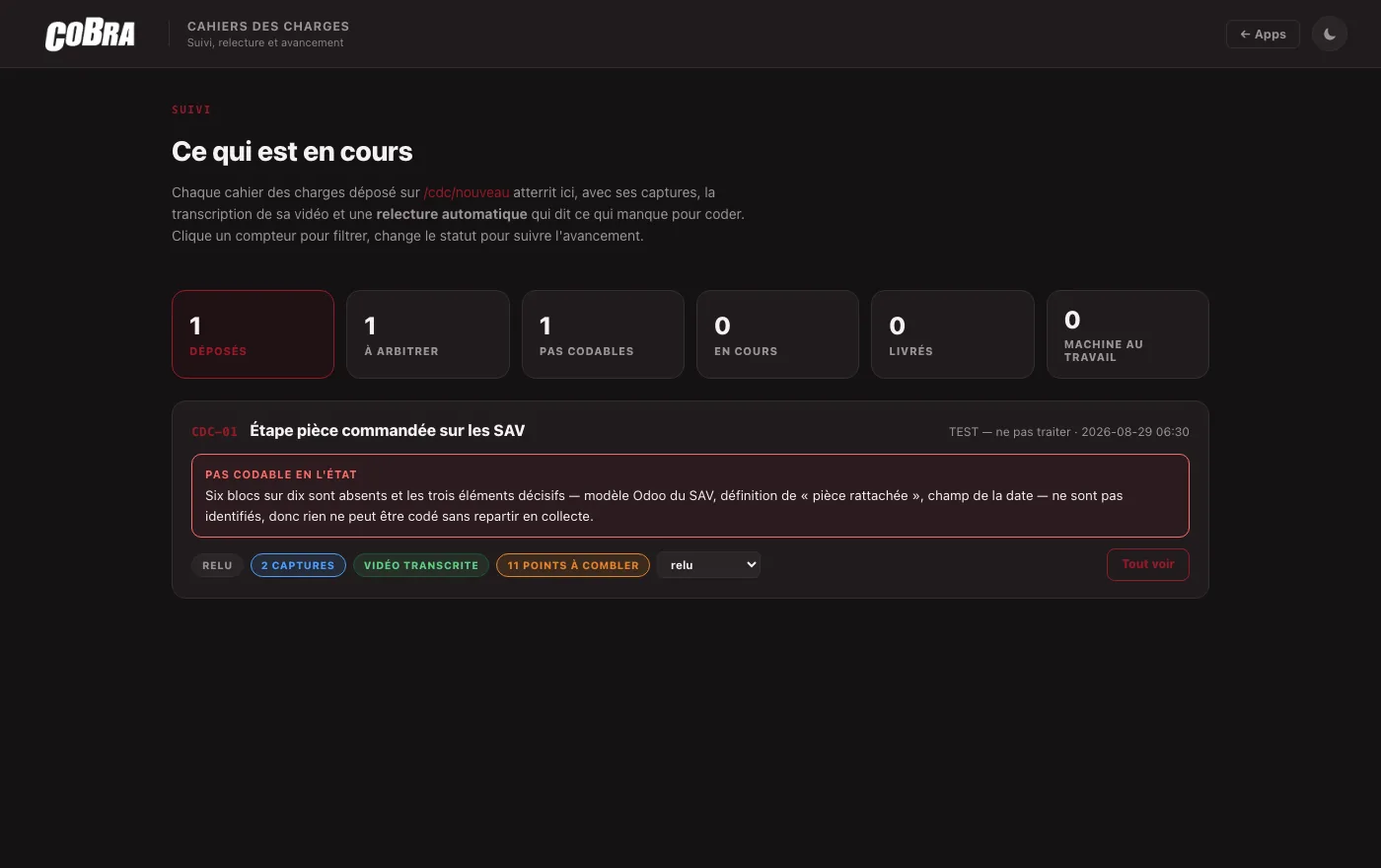
- A tracking page: verdict, what's missing, and an editable life cycle — to review → reviewed → in progress → in pre-prod → delivered.
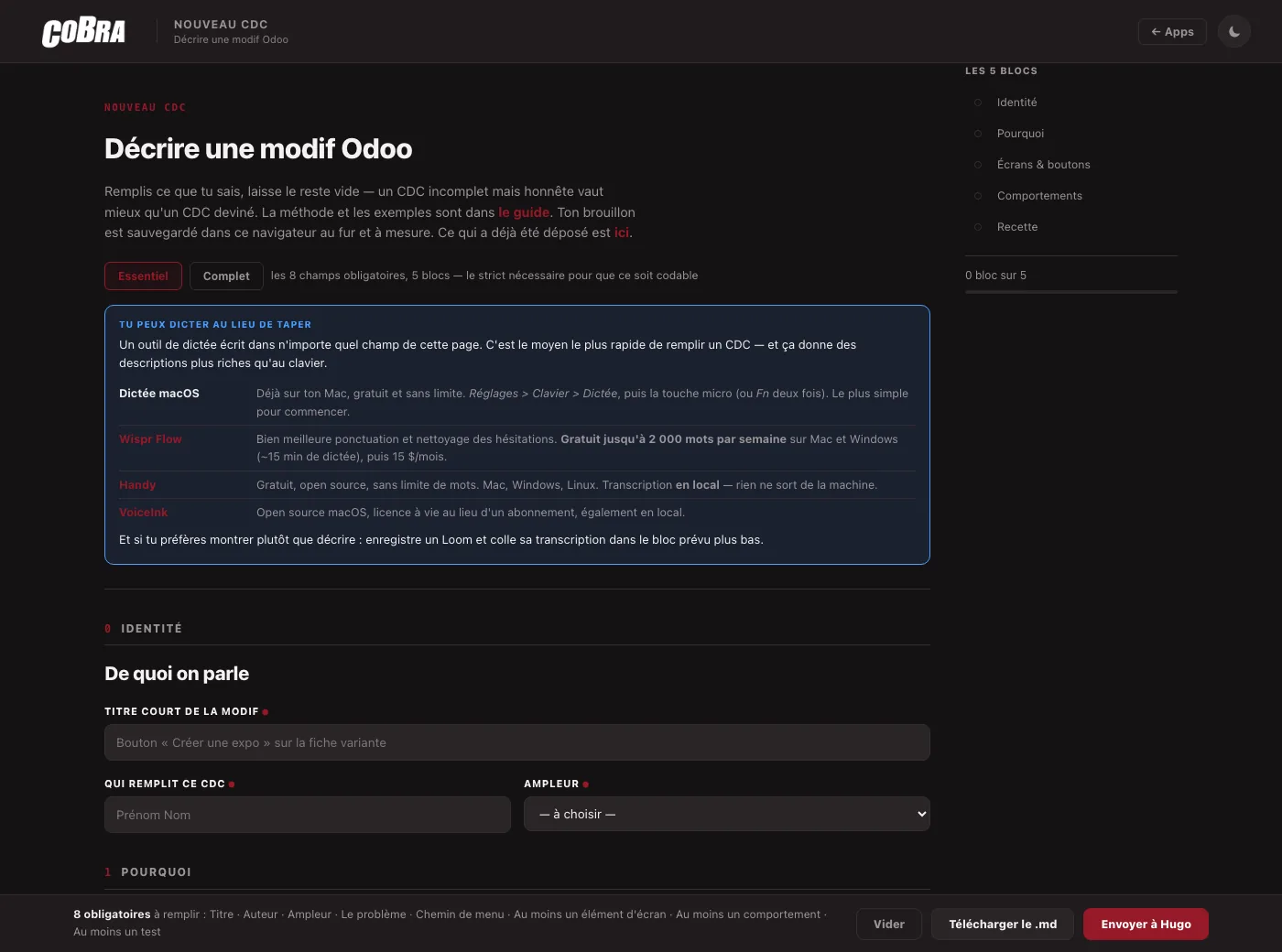
Result: the review runs in ~100 seconds for about 15,000 tokens, i.e. a few cents per request; transcribing a 5-minute video costs about three. On the test requests, it returned "not codable as is" with 9 then 11 points to fill — each phrased with the exact question to ask the author.
What was hard / what we learned
A model must not assert things about a system it can't see. Hence two passes instead of one. The first returns JSON — missing blocks, gaps, edge cases — plus a list of checks to run in the database. The server runs them read-only: whether a model exists, whether a field exists and its type, with a whitelist of methods and a cap of twelve checks. The second pass writes knowing the facts.
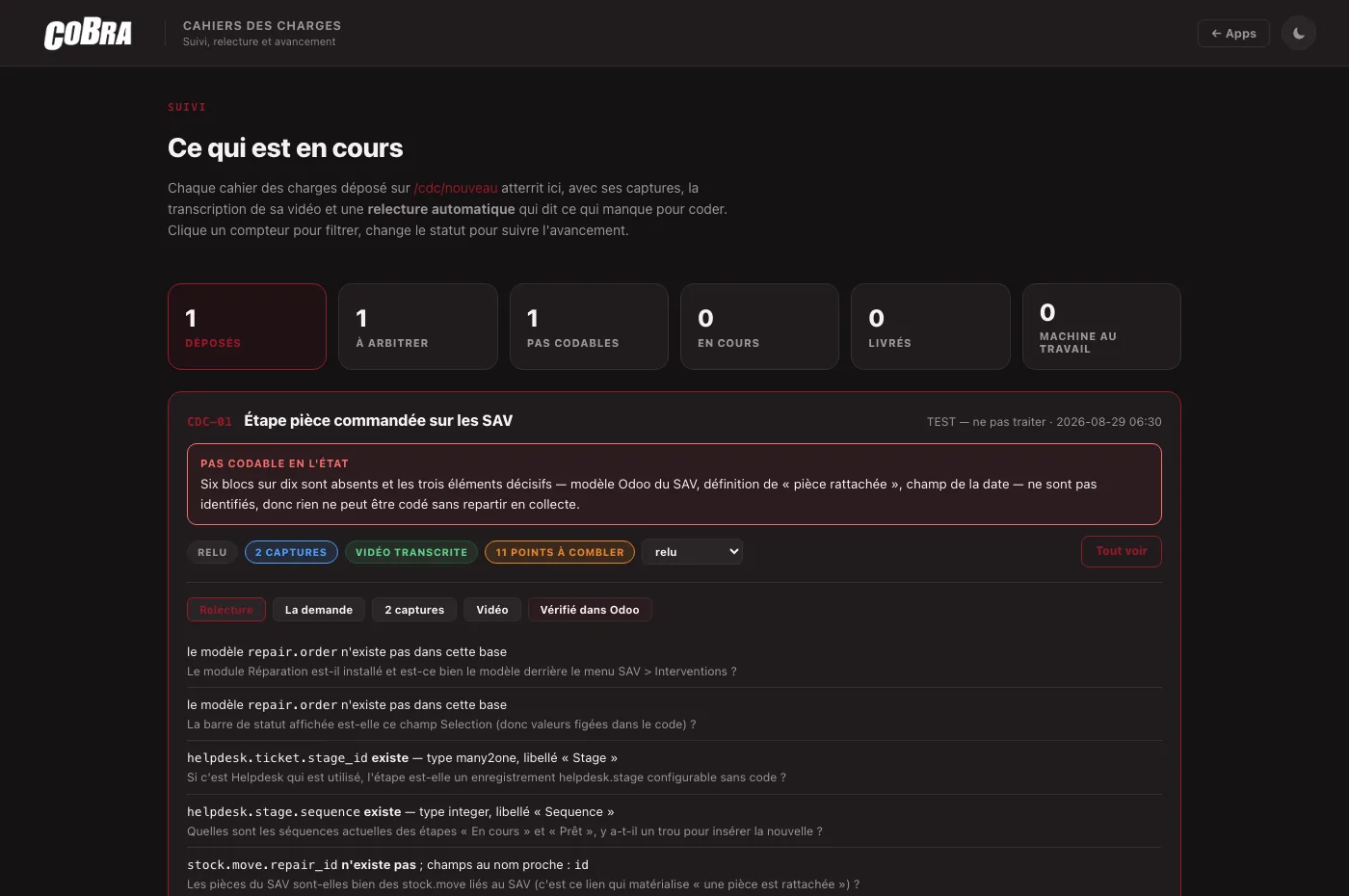
The gap between the two is stark. One request cited a margin field as if it existed: it doesn't, and the review found the two standard fields actually present in the database. Another described a change to the repair module: the model repair.order doesn't exist in the installation, and the review concluded that the subject was in fact a Helpdesk ticket — so "adding a stage to a Helpdesk status bar is data configuration, not development". A dev request had just turned into ten minutes of setup.
But the best point wasn't technical. The request was justified by "fifteen calls to the supplier a week", and the review noticed the proposed solution didn't remove them: "one more manual step avoids no call: it says ‹ we've ordered ›, not ‹ when it arrives ›". That's exactly the gap between the stated need and the imagined solution that a rushed human reviewer lets through — and that you normally only discover once the feature is shipped.
A notification channel wired to production has no test mode. My trials sent real alerts to the phone, one bearing a colleague's first name as the request's author. Hugo thought a real request had just come in. Two fixes: a switch to mute notifications during a test run, and test data that's visibly fake — the author is now called "TEST — do not process". The cost of that mistake wasn't technical, it was in trust.
The day the feature ships, the doc describing it becomes false. The guide still asked to paste the transcript by hand while the server was already doing it on its own. Hugo caught it, not me. Updating the instructions has to be part of the same pass as the deploy, not a later cleanup.
Stack
Odoo 18 queried over XML-RPC read-only, Python and Flask for the submission service, ffmpeg for audio extraction, a speech-transcription model, the Claude API (Opus 5) for the two-pass review, Caddy and systemd for exposure and supervision, static HTML pages in the house style, and a notification to mobile. All on a small instance already in place.
What this illustrates
We often expect an AI to write the code. The gain was elsewhere: having it verify what the request assumes, before anyone codes. The pattern that works has three beats — the model asks structured questions, the system answers with facts verifiable read-only, the model concludes knowingly. We never ask it to guess the state of the system, and we never let it write to it.
A less technical corollary: two minutes spent describing a request well save three round trips. The tool's role isn't to replace the person asking, it's to make it easy for them to ask well. And sometimes, the best answer to a development request is that there's no development to do.